Disclosure: This post may contain affiliate links, meaning Beautiful Christian Life LLC may get a commission if you decide to make a purchase through its links, at no cost to you.
Last year, during our trip to Israel, I had the opportunity to visit En Gedi. The word En Gedi means “spring of the wild goat.” En Gedi is a lush and vibrant oasis in the middle of the Judean Wilderness. What makes it so remarkable is its close proximity to the Dead Sea. Everything in the surrounding area is lifeless. Yet, wild goats feed off the verdant plants that grow at En Gedi. A steady flowing stream of water rushes through the middle of the oasis. Surrounding this stream are rocky cliffs spotted with caves. It is in those caves where David hid while on the run from King Saul in the Old Testament.
1 Samuel 24:1-2 says,
When Saul returned from following the Philistines, he was told, “Behold, David is in the wilderness of Engedi.” Then Saul took three thousand chosen men out of all Israel and went to seek David and his men in front of the Wildgoats’ Rocks.
In those caves, frightened and alone, David penned at least two psalms, Psalm 57 and 142.
Many of us know what it’s like to be at the end of our rope, to feel stuck with nowhere to turn.
In Psalm 142, David cries out to the Lord for help and hope:
With my voice I cry out to the LORD; with my voice I plead for mercy to the LORD. I pour out my complaint before him; I tell my trouble before him. (Ps. 142:1-2)
He tells the Lord exactly how he is feeling and what he is going through. He says, “My spirit faints within me” (Ps. 142:3); “I am brought very low”; and “Deliver me from my persecutors, for they are too strong for me!” (Ps. 142:6).
While few of us have been on the run from our enemies as David was, many of us do know what it’s like to be at the end of our rope, to feel stuck with nowhere to turn. We know what it feels like to be in despair or to feel lost and alone. We know what it’s like to be afraid. We know what it’s like to face something so frightening, we can’t imagine any way around it. We know what it’s like to look for help and find none (Ps. 142:4).
In the midst of that terrifying circumstance. David turned to the LORD God. He turned to the great I Am for help and hope.
For those of us who find ourselves with similar emotions to what David writes about in Psalm 142, there are three comforting things we can remember from this passage.
1. God knows us intimately.
In verse three, David writes, “When my spirit faints within me, you know my way!” Our God is an omniscient God. He knows all things. He knows the end from the beginning. He is never surprised or caught off guard by the circumstances of our lives. And he knows us intimately. As David wrote elsewhere,
O LORD, you have searched me and known me! You know when I sit down and when I rise up; you discern my thoughts from afar. You search out my path and my lying down and are acquainted with all my ways. Even before a word is on my tongue, behold, O LORD, you know it altogether. (Ps. 139:1-4)
God knows just what to do in all circumstances. And he knows what is best for us. John Calvin encourages us to rest in the fact that God knows:
God knew the way to deliver him, while his own mind was distracted by a variety of thoughts, and yet could not conceive any mode of extrication. The words teach us, when we have tried every remedy and know not what to do, to rest satisfied with the conviction that God is acquainted with our afflictions, and condescends to care for us, as Abraham said — "The Lord will provide." (Genesis 22:8.) (John Calvin’s Commentaries on the Psalms 119-150)
2. God is our refuge.
David turned to God because he knew God was his refuge. “I cry to you, O LORD; I say, ‘You are my refuge, my portion in the land of the living’” (Ps. 142:5). The Hebrew word for refuge is machaseh, which means hope, place of refuge, shelter, or trust (Strong’s Concordance, 4268). David put his trust and hope in God.
In the midst of your current trial, wherein do you place your hope and trust? It’s easy to turn to false refuges, to run and hide in metaphorical caves, or to seek out hope in created things rather than in the Creator. But those false refuges will only let us down. God alone is our place of safety. And it’s only in God that we find all we need. Like the Levites who had no land of their own, God is our portion; he is our inheritance. He is our Father and we are his children. We can call on him anytime and anywhere and know that he hears us. We can trust him to be our refuge and hope in times of trouble.
3. God will deliver us.
David ends his psalm with confidence. “The righteous will surround me, for you will deal bountifully with me” (Ps. 142:7). The armies that surrounded David were stronger than he was, but he knew God was stronger still. He knew and expected that God would deliver him. He knew he would once again be surrounded by God’s people.
Though the effects of the fall ravage our lives, though sin seems to have a grip on us, though evil appears to be winning, God is our deliverer. We only have to look to Christ and what he has accomplished for us in his life, death, resurrection, and ascension. He brought us from death to life. He redeemed us from slavery to sin. He made peace for us with God. He gave us the gift of his Spirit to change and transform us. Because of Christ, we too can face the hard circumstances of life with confidence, not in ourselves, but in who Christ is for us.
Dear friend, when life is hard, cry out to God in lament. Tell him your sorrows and fears. Ask for his help and deliverance. Put your hope and trust in him, for he is your refuge and portion.
Disclosure: This post may contain affiliate links, meaning Beautiful Christian Life LLC may get a commission if you decide to make a purchase through its links, at no cost to you.
If you are anything like me (Type A, a little tightly wound and productivity-oriented—but in the most lovable and laid-back way), interruptions are most likely not your favorite thing. Providentially, I am at a point in my life in which I am not working outside of the home, and I have two young children at my heels all day, ages two and four. Some days it feels like my whole day was an interruption. I wake up in the morning with a very productive day planned out in front of me, and often times find myself struggling to recall at the end of the day what I “accomplished.”
It is at these times we need to be reminded of the vital importance of loving, nurturing, and caring for our children, even when doing so seems to “get in the way” of the many tasks and duties that are required of a parent every day. Children are needy, easily distracted, and in constant need of correction. As much as we love our children with all that we are, sometimes it is tempting to long for the luxury of just being left alone.
Correcting little ones for the same things over and over gets exhausting. Have you ever found yourself thinking, “Why are my children doing this again? They were just disciplined for this yesterday!” How quickly we forget that as parents we often battle the same sins again and again as well. Children have a way of exposing our own sin.
Discipline should be an opportunity for a moment of grace.
I have been reading a book on parenting that I highly recommend,Parenting: 14 Gospel Principles That Can Radically Change Your Family (Crossway, 2016) by Paul Tripp. The book reminded me of my calling to my children and not only encouraged me to endure these interruptions, but also to thank God for them and to see them as moments of grace. Tripp reminds us that we are the first experience with authority our children have. We set the tone in their lives with what it looks like to have authority and how they are expected to submit to it.
As tempting as it is to simply set rules, play judge, and then throw down the hammer, overlooking loving, biblical instruction is a huge opportunity missed. Tripp reminds us that this authority we are given is ambassadorial authority from the King himself—we have no authority of our own. These precious lambs in our care are not ours but belong to God. Therefore, we are to reflect the authority of our heavenly Father.
In the lives of your children, you are the look of God’s face, you are the touch of his hand, and you are the tone of his voice. (Tripp, p. 116)
Wow, that thought alone caused me to pause. How often does my correction of my children meet that definition? Less often than I would like, to say the least.
Discipline should be a good moment of parenting.
Tripp goes on to explain how these constant interruptions should be welcomed:
Be thankful for these little moments. Don’t look at them as the bad moments of parenting, as hassles and interruptions; these are the good moments of parenting. These are moments of grace. (Tripp, p. 118)
These seemingly insignificant battles over sharing toys or finishing chores or arguing with siblings are the everyday moments in which our children are exposing their sinful hearts and giving us opportunities to lovingly correct and instruct them. As tempting as it is to address the behavior itself and leave it at that, there is such an opportunity missed to get at the heart of the real issue and explain to them why they act the way they do and why they have hope to conquer the sin that is within them.
May we all learn to slow down, embrace these moments of grace, and point our children to their Savior with every opportunity we are given.
This article was originally published on March 18, 2018.
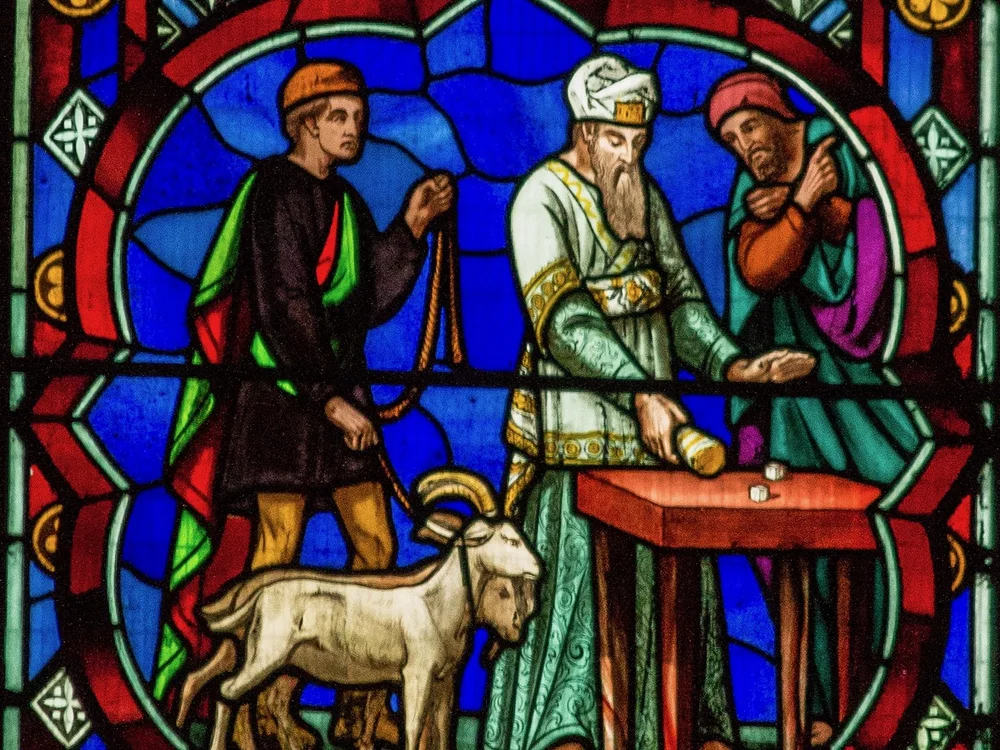
Photo Credit: Aaron casting lots (Lev. 16:8); detail of the East Window, Lincoln Cathedral; image from Wikimedia Commons.
Disclosure: This post may contain affiliate links, meaning Beautiful Christian Life LLC may get a commission if you decide to make a purchase through its links, at no cost to you.
Unlike our beloved Anglican cousins, Presbyterians don't believe that it is right to ordain priests into the church. But that doesn’t mean that we don’t think that we need a priest. On the contrary, we most desperately need a priest! Not a mere human priest, however, but the one great High Priest, Jesus Christ.
For every high priest chosen from among men is appointed to act on behalf of men in relation to God, to offer gifts and sacrifices for sins. He can deal gently with the ignorant and wayward, since he himself is beset with weakness. Because of this he is obligated to offer sacrifice for his own sins just as he does for those of the people. And no one takes this honor for himself, but only when called by God, just as Aaron was. (Heb. 5:1-4)
First, what is a priest? A priest is a go-between, someone who represents God before humanity, and humanity before God. A go-between is needed because God is holy, and we are not.
The Holy God hates sin with a passion and breaks out against it with fierce anger (remember the Flood, the Ten Plagues, the Exile...). But we are sin-full. In the West Australian town of Greenough, constant strong winds have bent the trees to grow right-angled to the ground. Humans are bent by sin to do what God has forbidden, and to fail to do what God has commanded.
Sinners cannot stand in God’s holy presence without being destroyed.
This is why Isaiah said “Woe to me! I am ruined!” when he found himself in the presence of the “Holy! Holy! Holy! LORD Almighty!” (Isa. 6:1-5). This is why the Beloved Disciple, confronted by the Holy Son of God, fell at his feet “as though dead” (Rev. 1:17).
Sinful humanity must come to God to plead for his mercy and blessing. But how can we? It isn’t safe to be around him, since we would be destroyed in his presence like a tissue in a bonfire, like a comet straying near the sun, disintegrated to ashes by the nuclear heat.
God on his side longs to bring us grace, forgiveness, and blessing. But how can he? His holy presence would destroy us, we who are fouled black by sin to our very core.
Two nations are at war, trying with might and main to obliterate one another. If there is to be any dialogue, any hope of reconciliation, a go-between is needed: traditionally, someone from neutral Switzerland. We need a Switzerland: a go-between to approach God on our behalf, to plead for his mercy and blessing; and someone who can come from God to us, to bring mercy and blessing. That is what a priest is. He represents sinful humanity before Holy God, and Holy God before sinful humanity.
A priest must have two qualifications.
First, in order to represent humanity, a priest must be one of us. He must know what we know, he must have felt and experienced what we have felt, to plead for us from a place of personal knowledge and encounter. Yet, though human, he must be sinless, so that he can enter Holy God’s presence without annihilation.
Second, in order to represent God, the priest must himself be divine. A true mediator between God and man must himself be—a God-man.
A priest has duties to perform.
In order to reconcile Holy God and sinful humanity, the priest must satisfy God’s demand for the execution of just punishment upon human sin. God can no more overlook and disregard sin than a human justice can overlook premeditated murder. If God and humanity is to be reconciled, human sin must be dealt with.
How can God bless sinful humanity, when he must punish us? God in his wisdom and grace has provided a sacrifice: a means by which our sin can be punished in another, in a substitute.
Just punishment for our sin can be executed upon the substitute, so that we may instead be blessed. The priest can make this sacrifice, and then bring evidence to God that the sacrifice has been made, and that sin has been justly punished. The priest brings the blood of the slain victim: “Look, here is the evidence that this person’s sin has been punished, that justice has been administered.”
God sees the blood of the substitute, and his holy justice is satisfied. The person for whom the sacrifice was made is no longer the object of his wrath: for his wrath has already fallen upon the sacrificial victim.
Then God sends the priest back to the people he represents: to pronounce God’s forgiveness and favor, God’s promises and reassurance.
The high priest was Israel’s only priest.
This was the awesome office and duty of the Old Testament priest: he was a mutual representative of Holy God and sinful humanity; he brought bloody evidence to God that Israel’s sin had been justly punished; he took God’s blessing to Israel, whose sin had been lifted.
The singular magnificence of the dress of the high priest showed that he was actually Israel’s only priest—the other “ordinary priests” merely served as his assistants. He wore a linen turban, with a gold plate engraved with the words “Holy to the LORD.” Over his heart he wore a breastplate, set with twelve precious jewels each engraved with the name of a tribe of Israel. On his shoulders he bore two stones engraved likewise with the names of the twelve tribes. Thus, he bore the nation upon his heart and shoulders, and the hope of all Israel rested upon him.
And once a year, on the Day of Atonement, he entered into the Most Holy Place of the Tabernacle, where the Ark of the Covenant was placed—between whose golden cherubim God was enthroned. He came on behalf of all Israel, bringing the blood of a sacrifice, a goat slaughtered on behalf of the people. Thus he communicated to God: “The sin of the people has been paid for. Your holy justice is satisfied. Forgive your people, and fulfill your covenant promises to them.” From God’s presence he returned to the people, to declare them clean from all sin (Lev. 16:30).
Though this ritual was spectacular, Hebrews says that Israel’s high priests were only a picture and shadow of the one true and heavenly High Priest: God’s Son, Jesus Christ.
How do we know that the Old Testament high priests were not the true and actual High Priest?
First, because they did their job not in God’s true throne room, but in an earthly tabernacle, a mere picture and representation of the heavenly reality.
Second, because the high priests offered the blood of sacrificed animals to God, and the blood of animals can never pay for the sins of a human being (Heb. 10:4). Thus, the sacrifices they brought were pictures of a coming future reality.
Third, because these high priests were themselves sinful! They could never safely enter the true presence of God.
Jesus, however, is the true High Priest.
The author of Hebrews states,
So also Christ did not exalt himself to be made a high priest, but was appointed by him who said to him,
“You are my Son,
today I have begotten you”;
as he says also in another place,
“You are a priest forever,
after the order of Melchizedek.” (Heb. 5:5-6)
The full significance of “the order of Melchizedek” will be explained later in Hebrews. Suffice to say that the true High Priest would have to come from an order quantumly different from that of the sinful earthly priests, and Jesus comes from this different order, the “order of Melchizedek.”
And Jesus proved himself to be a perfect representative of humanity:
In the days of his flesh, Jesus offered up prayers and supplications, with loud cries and tears, to him who was able to save him from death, and he was heard because of his reverence. Although he was a son, he learned obedience through what he suffered.And being made perfect, he became the source of eternal salvation to all who obey him, being designated by God a high priest after the order of Melchizedek. (Heb. 5:7-10)
Jesus prayed for us:
Very early in the morning, while it was still dark, he got up, left the house and went off to a solitary place, where he prayed. (Mark 1:35)
He brought petitions on our behalf:
“Holy Father, protect them by the power of your name.” (John 17:11)
“Protect them from the evil one…. Sanctify them by the truth.” (John 17:15-17)
“Father, I want those you have given me to be with me where I am, and to see my glory.” (John 17:24)
And being in anguish, he prayed more earnestly, and his sweat was like drops of blood falling to the ground. (Luke 22:44)
Even while they pounded spikes through his hands and feet, he cried:
“Father, forgive them, for they do not know what they are doing.” (Luke 23:34)
And Jesus learned to be obedient to God:
[He] grew in wisdom and stature, and in favor with God and men. (Luke 2:52)
He suffered—not least in the crucible of his desert temptations—and his suffering taught him obedience and dependence upon God.
And so Jesus became a High Priest perfectly equipped to represent us.
The author of Hebrews goes on to declare the following:
For we do not have a high priest who is unable to sympathize with our weaknesses, but we have one who has been tempted in every way, just as we are—yet was without sin. (Heb. 4:15)
If, as I believe to be true, Hebrews is a recorded sermon, the preacher seems conscious right here that what he is saying is quite challenging. Perhaps the congregation was beginning to fade, thinking, “This is all so theological and theoretical: can’t we just get back to the simple basics!”
And so he says:
About this we have much to say, and it is hard to explain, since you have become dull of hearing. For though by this time you ought to be teachers, you need someone to teach you again the basic principles of the oracles of God. You need milk, not solid food, for everyone who lives on milk is unskilled in the word of righteousness, since he is a child. But solid food is for the mature, for those who have their powers of discernment trained by constant practice to distinguish good from evil. Therefore let us leave the elementary doctrine of Christ and go on to maturity, not laying again a foundation of repentance from dead works and of faith toward God, and of instruction about washings, the laying on of hands, the resurrection of the dead, and eternal judgment. And this we will do if God permits. (Heb. 5:11-6:3)
If we are not going to fall away from Christ, if we are going to make it, then we need deep and wide knowledge.
The reason is this: we are attacked on a hundred fronts with a hundred brutal weapons—untold trials and temptations attacking the mind, soul, and spirit. We can only resist these attacks if we know how to answer them.
If we feed on milk, we will remain defenseless infants, gurgling and kicking helplessly with our fat little legs. My son plays Rugby Union. It is a tough game, and he would never last if he lived off milk and baby food. He needs meat and solid food if he is going to survive the scrum, if he is going to tackle his opponents into the ground, and if he is going to break through to the try line. This is why Sunday preaching is so important, and Bible studies and reading and self-feeding.
This is the meat you need—to know that Jesus is your great High Priest.
Are you falling prey to discouragement and temptation? Are you falling over at every struggle? This is the meat you need—to know that Jesus is your great High Priest:
We have this hope as an anchor for the soul, firm and secure. It enters the inner sanctuary behind the curtain, where our forerunner, Jesus, has entered on our behalf. He has become a high priest forever, in the order of Melchizedek. (Heb. 6:19-20)
We are ships in a black and towering gale. With Jesus as your High Priest, you are anchored behind the veil into the presence of God himself: anchored to his forgiveness, and anchored to his blessing, favor, and love. You are anchored there because Jesus is standing right there, representing you. He brings the blood of a sacrifice—his blood—evidence that your sins have been punished and dealt with. With Jesus as your High Priest you have absolute assurance that you are free from condemnation. And he brings to you, from God, abundant mercy, forgiveness, and life.
And because Jesus knows you—for he himself endured trials and temptations—he brings you exactly the help you need for each and every daily trial. Every trial. In Jesus Christ alone you have a firm and secure anchor for your soul.
Disclosure: This post may contain affiliate links, meaning Beautiful Christian Life LLC may get a commission if you decide to make a purchase through its links, at no cost to you.
My family moved to St. Simons Island, Georgia, in 1989 when I was twelve years old. One of the first things that I distinctly remember about that beautiful, little, secluded island was the fact that we could walk into a store, write our name on a ledger, and walk out with just about whatever we wanted in the store. I remember my dad and mom talking about needing to pay off their account at the hardware store every month. The owners and my parents both wanted to keep “short accounts.”
It was a peculiar and fascinating experience for a boy who moved there from a major city in which that would have never happened. The population of the island was small enough at that time for store owners to feel as if they could offer that service. Needless to say, it didn't last long.
Within a year or two, you could no longer do so. It is somewhat tragic that this practice isn’t part of our culture anymore, because it serves as an illustration of an important aspect of our spiritual life. In the Christian life, we are—as the Puritans used to say—to “keep short accounts with God and men.” So, what do short accounts look like in the Christian life? Here are a few thoughts:
1. Confess your sins.
Believers are people who confess their sin. That is part and parcel of what it means to be a Christian. If a man or woman, boy or girl, never confesses their sin, they reveal that they do not believe that they are sinners in need of a Savior. A true believer is one who has learned, by the work of the Holy Spirit to say, “Will you please forgive me?” This is true in the vertical dimension of our relationship with God, first and foremost, and it is true in the horizontal relationships we have with others.
If we don't confess our sin, we evidence that we are not sincere in our profession of faith in Christ. We must first confess our sins to the Lord. We learn this from Psalm 51 where David prays, “‘Against You and You only have I sinned’” (Ps. 51:4). Even though David had sinned against Uriah, Bathsheba, both of their families, his family and all of Israel, he viewed his sin, first and foremost, as that which he committed against the Lord. It was sin because he broke God’s law.
We too must first go to the Lord and then to others. When we go to others, but not to the Lord, we functionally act like the man or woman who goes to the priest in the confessional but not to God in heaven.
2. Confess your sins particularly.
The Westminster Confession of Faith has an intriguing statement about this in its chapter on repentance where we read,
Men ought not to content themselves with a general repentance, but it is every man's duty to endeavor to repent of his particular sins, particularly. (WCF 15.5)
In short, we must never conclude that it is sufficient to confess that we are generally sinners or that we have generally sinned. When we confess our sin to God and men, we are to confess our sins specifically. We are to own the guilt of the particular sins that we have done. We are to examine our actions against the Law of God (i.e.the Ten Commandments) and confess the particular ways in which we have broken his law.
My wife and I try to teach our boys to do this when they have sinned against one another. We teach them not to say, "I'm sorry." Instead, we seek to teach them to say, “Will you please forgive me for doing x, y or z?” We also try to do so in our marriage. It is good for husbands to ask their wives to forgive them for sinful anger, for lack of gentleness, lack of understanding, pride, laziness, indifference, etc.
Likewise, it is good for a wife to ask her husband to forgive her for all the ways that she has specifically failed to obey the Lord in her relationship to him. Members of the church also need to learn to confess particular sins to one another. When one member of the church has sinned against another, they need to go to the offended party and seek out their forgiveness for what they have specifically done wrong. Sadly, this occurs quite infrequently in the family, marriages, and the church.
3. Confess your sins quickly.
One of the sure signs that there is something out of alignment in your soul is that you do not go to the Lord and confess your sins as soon as you recognize that you have sinned against him. Pride keeps us from uninhibited confession of sin. The same is true with regard to our relationship to others.
Like the disciples in the Garden, our flesh would rather sleep than engage in the spiritual work of prayer—especially when we have sinned. The apostle Paul warned believers not to "let the sun go down" on sinful anger, because Satan will most certainly get a foothold in our relationships when we do so. We must learn to confess our sins quickly.
4. Confess your sins continually.
We must continually go to God and men in confession and contrition. We must resist the temptation to give into sin and stop confessing it. Confessing and seeking to forsake sin is one of the means of Christian growth in grace. When we stop doing so, we have begun the first step toward backsliding or apostasy.
It doesn't matter how many times we may fall into the same sin, we must go back to the Lord and back to those against whom we have sinned in order to seek our forgiveness. The Proverbs tell us, "The righteous falls seven times and rises again" (Prov. 24:16). When Simon Peter asked Jesus if he should forgive his brother seven times, Jesus told him to do so seventy times seven (Matt. 18:22). This means that we should repeatedly confess our sins to God and men—no matter how many times we have sinned.
5. Approach others when sinned against.
Part of keeping short accounts with others is going to them when you believe that they have sinned against you. Jesus taught us to do so when he said, “If your brother sins against you, go and tell him his fault, between you and him alone. If he listens to you, you have gained your brother” (Matt. 18:15).
It is just as much our responsibility to humbly and forthrightly address what we believe to be the spiritual debt of others to us as it is for them to come to us and confess their sin. This has got to be one of the least practiced, yet most important, parts of the Christian life.
In a culture that essentially says, “Live and let live,” believers need to learn what it means to go to and lovingly confront a brother or sister when they believe that he or she has personally sinned against them. Often, one believer is oblivious to the fact that he or she has sinned against another. Telling a brother or sister their fault is part of helping them keep short accounts with God and men.
6. Forgive others indiscriminately.
We must guard against only forgiving those we like. To do so would be to show affinity, not forgiveness. No matter who comes to us and asks us to forgive them, we are to stand ready to extend the forgiveness for which they are coming. We have no right to hold faults over the heads of those who have come to us because we don't like their personality.
I have seen some of the roughest of persons come to a place of deep brokenness over their sins—only to hear those they have sinned against criticize them for that roughness. We are not called to only forgive our friends. We are called to forgive any who repent and seek that forgiveness from us.
7. Forgive others continually.
As noted above, Jesus taught us to forgive an unlimited number of times (i.e., the sense of “seventy times seven”). We are all ready to write others off when they sin against us a certain number of times. One of my friends often reminds me that most relationships—because of the self-righteousness in our hearts—can only handle one or two offenses. Yet, when we remember how much God has forgiven us, how can we not repeatedly forgive others?
If we set a certain limit on how much we forgive others, we are in danger of having God hold our offenses against us. The parable of the two debtors (Luke 7:36-50) is a frightening indictment against those who do so. This does not mean that there will not be consequences for those who continually sin against another.
A husband who continually cheats on his wife is most certainly subject to her executing her God-given right to divorce him. She must, however, repeatedly and continually forgive him of his sin if he repents, just as God does for us in Christ.
While so much more could and should be said on this subject, what has been said should encourage us to make sure that our ledger is cleared. We need to be diligent to keep short accounts with God and men. In doing so, we will experience more of what it is to live by the grace of God in Christ, to live in gracious relationships with one another, and to be agents of grace in extending forgiveness to others.
Thisarticlewas originally published under the title “Keeping Short Accounts” atChristward Collective, a conversation of the Alliance of Confessing Evangelicals and was originally featured at Beautiful Christian Life on August 29, 2018.
Disclosure: This post may contain affiliate links, meaning Beautiful Christian Life LLC may get a commission if you decide to make a purchase through its links, at no cost to you.
I’ve noticed something of a cultural shift in the way we evangelicals talk about the human condition: more and more, we are “broken” rather than “sinners”—people who act out of our “brokenness,” not our “sin,” “rebellion,” “disobedience,” or “rejection” of God. And I’m not convinced this shift is all good.
Let me be clear: I’m not talking about the frequency with which actual words are used—as if there’s a bingo card with words on it and the winning sermon or church service is one that ticks each box. What we communicate is about much more than the individual words we use. I don’t have to mention the water, waves, sand, and sunshine for you to know they’re included when I say, “The beach was nice.” So I’m not advocating a slavish adherence to a particular script or lexicon.
Nor am I advocating a slavish adherence to biblical vocabulary. My sense is that the Bible doesn’t use the language of “brokenness” for the human condition the way we do. Scripture mostly uses it for God’s acts of judgment against sinful people or nations (e.g., Ps. 2:9; 51:8; Isa. 1:28), and occasionally for the humbled and broken stance of true repentance (e.g., Ps. 51:17). In addition, the language of “brokenness” may be a culturally appropriate way to capture the meaning of words the Bible does use. Language changes, and we need to use language our hearers will understand.
As it happens, I think “broken” and “brokenness” are good terms to use with unbelievers, in public evangelism, and in preaching to the flock. They make sense of how people feel about the world and their lives. Relationships are broken. Sleep is broken. Hearts are broken. Laws are broken. Families are fractured. Hopes are shattered. And our strength and will are broken by it all.
And yet while the words “broken” and “brokenness” resonate with us all and have some explanatory power, they’re not enough to describe the human condition, and don’t deserve to be our dominant go-to vocabulary for it. In fact, I’d go further and say that if “broken” and “brokenness” become our dominant vocabulary, we will lose gospel clarity and effectiveness, rather than gain it. At worst, we lose the heart of the gospel itself and end up with a God who is, at best, domesticated or, at worst, unkind, unjust, and uncaring.
An overstatement? Perhaps. But here are ten things to consider:
The words “broken” and “brokenness” do not have an obvious moral or ethical element, unlike the older terminology of “sin,” “rebellion,” and “disobedience.”
“Broken” and “brokenness” do not convey a relational framework—at least, not in the way we commonly use them. We speak of us being broken, not our relationship with God. On the other hand, rebellion, rejection, and disobedience clearly happen in a relational context, and damage and even break relationships (as we all know). They explain why we are enemies of God, alienated from him and objects of his wrath.
With the biblical terminology for sin (in both Greek and English), the noun can also become an adjective, an active verb, and an adverb. So, for example, a sinner sins sinfully and a rebel rebels rebelliously. But “broken” terminology doesn’t allow the same linguistic movements. The active verb “break” doesn’t even feature in our use of this terminology, and a “broker” is someone who deals with shares, not someone who is by definition broken.
The terms “broken” and “brokenness” are used passively—in the sense that someone is broken by something or someone else. This means that someone who is broken is a victim and not morally responsible for their own brokenness. Of course, our brokenness may be a result of God’s judgment upon us, but few entertain that possibility! We only know that we are broken, and not by us. We are victims of nature and nurture, life and love.
“Broken” terminology focuses us on our pain and dysfunction, not on God’s holiness and righteousness. This is not inherently problematic. But on its own, it does nothing to challenge or correct the self-centered and humanity-centered worldview at the heart of human sin. It keeps us at the center of the universe, not God.
It’s not obvious why someone who is broken needs to be forgiven. In fact, it seems to be a category error: they’ve done nothing wrong. Their greatest need isn’t to have their guilt removed, but for healing, sympathy, a helping hand, and a fair go, and for those responsible for their brokenness to be called to account.
If we are broken through no fault of our own, then it is unfair, unreasonable, and unloving for God to judge us. We are victims, so how could it be right for us to bear the blame? Either God doesn’t know we’re not to blame, or he doesn’t care—and what sort of God is that?
And if God cannot be our judge, his response to our problem can only be one of pity, not of mercy or grace. Worse still, it’s pity for our suffering, rather than boundless mercy and grace expressed in his pardon.
A gospel for broken people is one that offers healing, restoration, and wholeness. Like the true gospel, it may be free, but there can be no call for repentance because there is no wrong to repent of. Like the true gospel, it may offer hope, but it is the hope of the good life in this world—of emotional, relational, and material success—not the hope of eternal rest in Christ. Like the true gospel, it recognizes that relationships are broken, but doesn’t tell me how I became an enemy of God. And like the true gospel, it recognizes that there is something wrong with me, but fails to address the evil in my heart.
Finally, on this therapeutic model, it is not clear why Christ had to die. There is no penalty or ransom to be paid. No judge to satisfy. No holy love to appease. In fact, the cross seems to add more meaningless suffering to a broken world filled with meaningless suffering.
Now, I’m not saying that everyone who uses this language of “brokenness” drifts into all these errors! And I’m not saying that “brokenness” language isn’t sometimes helpful. What I am saying is that if all we ever (or mostly) use is “brokenness” language, this is what our hearers might hear—and that would be a distortion of the truth. Not only does it make us the center of the gospel and the world, it can place God on the wrong side of the ledger—in company with all those who are against us. At best, it portrays him as a celestial therapist who is there to help us put our lives back together.
It’s probably true that the older terminology of “sin” and “sinners,” “rebellion” and “rebels,” disobedience, rejection, and so on, is not everyday language. It may need more explanation than it once did, and it may have cultural baggage attached that we need to unpack. It may also be that, in our culture of pathologization and victimhood, it will jar to say that we have a fatal problem of the heart of our own making. But that doesn’t mean we shouldn’t say it.
Perhaps the way ahead is to combine the old and the new so that the strengths of both are harnessed: we are broken sinners living in a broken and fallen world.
Thisarticlewas first published on GoThereFor.com, an online library and resource center for disciples making disciples, and has been re-titled and republished with permission.
Disclosure: This post may contain affiliate links, meaning Beautiful Christian Life LLC may get a commission if you decide to make a purchase through its links, at no cost to you.
Is there a dream you’ve been holding onto for a long time and it hasn’t come true yet? Maybe you’re worried and anxious that it isn’t ever going to happen. Maybe you’re wondering if God really loves you after all. Here are five good things to remember in such times:
1. God still loves you.
We know from reading the Bible that God allowed his dear saints to go through various grievous trials. Because you are suffering right now in some way does not mean that God has forsaken you. He still loves you. Below are some of many examples from Scripture of this great truth:
God still loved Adam and Eve when he had an angel drive them out of the garden of Eden (Gen. 3:22-24).
God still loved Abraham and Sarah while they waited until very old age to have the promised child, Isaac. (Gen. 16:1; 17:15-21)
God still loved Joseph when he was both thrown into a pit by his envious brothers and put in prison (Gen. 37:18-24; 39:19-21).
God still loved Hannah when she wept bitterly over being barren (1 Sam. 1:10)
God still loved David when he was persecuted by Saul and had to flee for his life (1 Sam. 21:10).
God still loved Jonah when he ran away from God’s command to warn Nineveh (Jonah 1:3).
God still loved Peter when he denied his Lord (Luke 22:54-62).
God still loved Stephen when he was stoned for proclaiming the gospel (Acts 7:54-60).
God still loved Paul while he was shipwrecked, beaten, and held in chains in prison for preaching the gospel (Acts 27:27-44; 2 Cor. 11:25; Phil. 1:14).
God still loved John when he was exiled on the island of Patmos (Rev. 1:9).
Because we have the benefit of hindsight through the reading of God’s true word, we can see how God was with these and many more saints amid great adversities. Being God’s beloved does not mean life will go smoothly for us. In fact, Jesus told his disciples that they would have tribulation in this world (John 16:33).
2. God is at work in your life.
You may be certain that your dream will bring you happiness, but this is often not the case. Whether you want to climb a certain mountain, marry, achieve certain career goals, have children, look a certain way, or be well off financially, you probably know of people who have some or maybe many of these things and are still not happy. They may even be quite miserable.
Furthermore, if we have lived into adulthood and are honest with ourselves, we can all think of things we personally wanted that would have been destructive in some way in the long run. It is good to work diligently and honorably to make our dreams come true, but God may have a different and better plan for us:
The heart of man plans his way, but the LORD establishes his steps. (Prov. 16:9)
Many are the plans in the mind of a man, but it is the purpose of the Lord that will stand. (Prov. 19:21)
And we know that for those who love God all things work together for good, for those who are called according to his purpose. (Rom. 8:28)
In him we have obtained an inheritance, having been predestined according to the purpose of him who works all things according to the counsel of his will. (Eph. 1:11)
Even though we may not understand why doors are shut in our life, we can trust that nothing ever happens to us that has not been allowed by God. He has a purpose in all he ordains, and we need to trust him even when things might not make sense to us right now.
3. God hasn’t made a mistake.
Have you ever felt like saying, “Why did you let that happen, God?” or “Why wouldn’t God want to fulfill this good and godly dream of mine?” We can take great comfort in recognizing that God knows all our hopes and dreams. He knows how disappointed we are. He also knows the past, present, and future. Because he is all-knowing and good and loving, we can trust that he has a reason for not fulfilling our dream:
O Lord, you have searched me and known me!
You know when I sit down and when I rise up;
you discern my thoughts from afar.
You search out my path and my lying down
and are acquainted with all my ways.
Even before a word is on my tongue,
behold, O Lord, you know it altogether. (Ps. 139:1-4)
Furthermore, we have limited knowledge. We can only see what God allows us to see. As David Gibson points out in his book Living Life Backward, “It is part of living well to accept two things: first, we are enclosed within time’s bounds, and, second, God is not” (p. 52). It’s easy to think, “If only I could go back in time and change this certain thing, then my life would have worked out the way I wanted.” This is foolish reasoning as we cannot possibly know what would have been if the past had been different.
The movie The Butterfly Effect tried to make this very point. The main character has the chance to go back in time to achieve the outcome he desires; yet, his intervention causes far more harm than good. Because God is loving, good, holy, beautiful, righteous, omniscient, omnipresent, and omnipotent, he will work all things together for good for those who love him.
4. You aren’t the main author of your life story.
It is essential to recognize, as Gibson writes, that “we are each writing the story of our lives, but we are not the main author” (p. 52). While we have control over our decisions on certain matters, many aspects of life are simply beyond our control—and that is a good thing. In his sermon series “The Crook in the Lot,” the eighteenth-century Scottish theologian and pastor Thomas Boston reminds us that at some point we will see even our great sufferings in the light of God’s good providence and care for us:
Standing on the shore and looking back to what they have passed through, they will be made to say, "He has done all things well" [Mark 7:37]. Those things which are bitter to Christians in the passing through are very sweet when we reflect on them.
You are special to God, so special that he gave his only begotten Son for you. Yet, while you are part of God’s story, you are not the whole story. Rejoice that God has included you in his overarching redemptive plan as his precious child, with full rights as a co-heir in Christ.
5. God makes everything beautiful in its time.
If you’re reading this, your life has not come to an end on this earth. It may be that your dream will come true—just not yet. Some saints prayed for decades before God granted their petitions, and you worship the same God they did. The God of Adam, Eve, Abraham, Sarah, Isaac, Jacob, Joseph, Hannah, David, Jonah, Peter, Stephen, Paul, and John is also your God.
Commit your way to your Savior, always trusting in him come what may, because no eye has seen, nor ear heard, nor the heart of man imagined, what God has prepared for those who love him (1 Cor. 2:9). And God’s future for his children is the best dream ever—and one that is sure to come true.
This article was originally published on October 13, 2020, under the title “5 Good Things to Remember When Your Dreams Haven’t Come True.”
Disclosure: This post may contain affiliate links, meaning Beautiful Christian Life LLC may get a commission if you decide to make a purchase through its links, at no cost to you.
To understand the importance of the statement “faith alone,” we need to remember why the Reformers sought to recover the doctrine of God’s grace. They wanted to emphasize the fact that we are made right with God not through any merit of our own but rather through God’s own free grace. In Christ, we receive unmerited favor from God.
The Roman Catholics in the sixteenth century would have agreed with this to some extent. They indeed believed we needed God’s grace to get to heaven. But how do we get the grace? Here’s what they said at the Council of Trent in 1547 (which is still Roman Catholic doctrine today):
If anyone says that the sinner is justified by faith alone, meaning that nothing else is required to cooperate in order to obtain the grace of justification, and that it is not in any way necessary that he be prepared and disposed by the action of his own will, let him be accursed. (Sixth Session, Canon IX)
Faith is the gift of God.
This is very strong language. What Rome is saying is that if you believe that it is purely by faith that you receive God’s grace, you will be accursed—that is, damned to hell. What’s the problem with this? It’s the very teaching of Scripture that they are condemning! Paul could not be clearer:
For by grace you have been saved through faith. And this is not your own doing; it is the gift of God, not a result of works, so that no one may boast. (Eph. 2:8-9)
Rome wanted to say that we are saved by God's grace in cooperation with faith and works. In fact, it even saw faith itself as one of the works that earns us God’s grace. But you can’t earn grace—otherwise, it’s not grace, not a gift. Rome taught a theological contradiction, one that Paul warned against in Ephesians 2.
In response to Rome’s perversion of biblical doctrine, the Reformers returned to the Scriptural truth that nothing we do can earn favor with God. We are saved by his grace, and the only way of receiving God’s grace is through the faith that he himself works in our hearts by means of his word and Holy Spirit. The Westminster Divines explained how faith can justify us before God, even though it’s something God himself gives us:
Faith justifies a sinner in the sight of God, not because of those other graces which do always accompany it, or of good works that are the fruits of it, nor as if the grace of faith, or any act thereof, were imputed to him for his justification; but only as it is an instrument by which he receives and applies Christ and his righteousness (Westminster Larger Catechism 73).
Faith is the instrument through which we receive Christ's benefits.
The Holy Spirit working faith in us is what unites us to Christ; and God justifies us not for anything we do but for Christ’s sake alone. Faith is the instrument, the channel whereby all the benefits of Christ are communicated to us and counted as ours. It is through faith that God imputes all of Christ’s righteousness to us, so that in Christ alone we “become the righteousness of God” (2 Cor. 5:21).
In this way, the Reformers were always cautious to make sure faith was understood in passive terms. That’s why the Westminster Confession of Faithdefines the “principle acts” of saving faith as “accepting, receiving, and resting upon Christ alone” (14.2). These three are all passive “acts.” Faith is about empty hands. It’s about leaning on Jesus. It’s about resting in him. It’s not about doing at all! This is what Paul stresses in Romans 10:
But the righteousness based on faith says, “Do not say in your heart, ‘Who will ascend into heaven?’” (that is, to bring Christ down) “or ‘Who will descend into the abyss?’” (that is, to bring Christ up from the dead). But what does it say? “The word is near you, in your mouth and in your heart” (that is, the word of faith that we proclaim); because, if you confess with your mouth that Jesus is Lord and believe in your heart that God raised him from the dead, you will be saved. For with the heart one believes and is justified (Rom. 10:6–10).
Being justified through faith alone causes Christians to be thankful and stirred up to do good works.
A common critique is that this doctrine makes for lazy Christians. The objection goes something like this: If I am justified merely by faith and not works, then there is no need for me to do good works. But the Reformers scoffed at that notion, because it misinterprets what God is doing for us through faith in Christ!
Since our salvation is secured by a gracious gift of saving belief in Christ’s works, then that will stir us up to love and good works. The First Helvetic Confession (1536) put it this way: “This is the only true worship of God: Faith most pregnant with works, faith I say with no confidence in the works.”
The Reformers rediscovered this doctrine of sola fide in the sixteenth century—but the real question is, have you discovered it today?
This article was originally published at Beautiful Christian Life on February 27, 2018, under the title "What Does 'Faith Alone' Mean, and Why Should You Care?"