Today on the broadcast I will be talking aboutChrist Has Set Us FreeGalatians 5:1-15Gal 5:1 Stand fast therefore in the liberty wherewith Christ hath made us free, and be not entangled again with the yoke of bondage.Gal 5:2 Behold, I Paul say unto you, that if ye be circumcised, Christ shall profit you nothing.Gal 5:3 For I testify again to every man that is circumcised, that he is a debtor to do the whole law.Gal 5:4 Christ is become of no effect unto you, whosoever of you are justified by the law; ye are fallen from grace.Gal 5:5 For we through the Spirit wait for the hope of righteousness by faith.Gal 5:6 For in Jesus Christ neither circumcision availeth any thing, nor uncircumcision; but faith which worketh by love.Gal 5:7 Ye did run well; who did hinder you that ye should not obey the truth?Gal 5:8 This persuasion cometh not of him that calleth you.Gal 5:9 A little leaven leaveneth the whole lump.Gal 5:10 I have confidence in you through the Lord, that ye will be none otherwise minded: but he that troubleth you shall bear his judgment, whosoever he be.Gal 5:11 And I, brethren, if I yet preach circumcision, why do I yet suffer persecution? then is the offence of the cross ceased.Gal 5:12 I would they were even cut off which trouble you.Gal 5:13 For, brethren, ye have been called unto liberty; only use not liberty for an occasion to the flesh, but by love serve one another.Gal 5:14 For all the law is fulfilled in one word, even in this; Thou shalt love thy neighbour as thyself.Gal 5:15 But if ye bite and devour one another, take heed that ye be not consumed one of another.
from Daily Bible Benefits with Pastor Bob Daley https://ift.tt/wDfpLnk
via IFTTT
Tuesday, May 23, 2023

When You Feel Threatened

“When they saw the courage of Peter and John and realized that they were unschooled, ordinary men, they were astonished and they took note that these men had been with Jesus.” Acts 4:13
Peter and John were unschooled, ordinary men. They weren’t superheroes or endowed with gifts and charisma that made them stand out in a crowd. In fact, they were so ordinary that the rulers and elders of the people knew instinctively that the courage they witnessed in Peter and John must be from another source. Their courage was so astonishing that others assumed they had to have been with Jesus.
Later in Acts 4, these same ordinary men faced interrogation and threats to their well-being if they continued to witness about Jesus. What ensued was incredible. They responded by telling the rulers and elders that they couldn’t help but speak of what they had seen and heard.
Peter and John shared their experience with their fellow believers and then they prayed,
“They did what your power and will had decided beforehand should happen. Now, Lord, consider their threats and enable your servants to speak your word with great boldness. Stretch out your hand to heal and perform miraculous signs and wonders through the name of your holy servant Jesus” (Acts 4:28-30).
They acknowledged to God that it was by His power and will that this experience happened. They asked for the Lord to display His majestic glory through them. Then they asked the Lord to enable them to speak with great boldness – not to help them run to the next town, not to be hidden from the threats, not to even remove or silence the threats – but to meet the challenge head on with even greater boldness.
What are your prayers like when you feel threatened?
Father God, thank you that you are able to give us what we need to become who we need to be in the face of our biggest challenges. Please give us the overcoming power to grasp your love, to obey your voice, and to cling to you for what is needed in the midst of whatever situation we face. Pour into us your strength and power, and may you ultimately be glorified. In Jesus’ Name! Amen.
By Donna Mitchell
Used by Permission
https://thelife.com/devotionals
Further Reading
• Forgiveness – Yourself / Others
• God Is…
SUBSCRIBE BY EMAIL: FOLLOW THIS LINK
Follow Us On: Facebook • Twitter • Instagram • Pinterest
The post When You Feel Threatened can be found online at Daily Devotionals by Thoughts about God.
from Daily Devotionals by Thoughts about God https://ift.tt/3wQBWT0
via IFTTT
Monday, May 22, 2023
The Comfort of Knowing God Is in Control

Photo by Christophe Morre on Unsplash
Disclosure: This post may contain affiliate links, meaning Beautiful Christian Life LLC may get a commission if you decide to make a purchase through its links, at no cost to you.
God's providence—what is it? The Westminster Shorter Catechism has a clear and concise definition:
God's works of providence are his most holy, wise, and powerful preserving, and governing all his creatures, and all their actions. (WSC 11)
In other words, since God is creator and ruler of all, everything that occurs happens according to his will, even things that appear to be and are awful. Tragedies like war, crime, and the death of a loved one happen according to the will of God.
God by his permissive will determines to allow for a time and purpose the sinful acts of humankind.
Yet, there are distinctions to be made. God is not the author of evil—Scripture is clear about that (James 1:13). God is perfectly and completely good and holy. Yet, God by his permissive will determines to allow for a time and purpose the sinful acts of humankind. The most notable example is the crucifixion of Christ Jesus:
”This Jesus, delivered up according to the definite plan and foreknowledge of God, you crucified and killed by the hands of lawless men." (Acts 2:23)
It was God's will that his Son die on the cross for the forgiveness of our sins; yet, it was sinfully done by human hands. From this we vividly learn that even our own sinful acts can and are used by God for his purposes, which are always "holy, wise, and powerful."
Over time, just as the flower of a bud opens, God begins to reveal the good he brings about through our sufferings.
So what are we to make of God's providence when hurt and pain and sadness come from tragedies in our lives? In the hymn "God Moves in a Mysterious Way," written by William Cowper (1774), the last two stanzas help us answer this question:
His purposes will ripen fast,
Unfolding ev'ry hour.
The bud may have a bitter taste,
But sweet will be the flow'r.
Blind unbelief is sure to err
And scan his work in vain.
God is his own interpreter,
And he will make it plain.
Cowper encourages us that, while recognizing the bud of some tragic and painful event in our lives may have a bitter taste, over time as the flower opens God begins to reveal the good he brings about through such suffering. God may show us the sweetness in full bloom, just as we see from Christ Jesus' resurrection after his crucifixion. The most terrible suffering and death of all time brings forgiveness, salvation, and love, even though at the time Jesus' crucifixion seemed the most unjust death imaginable.
God's providence brings about stronger faith, humility, and greater dependence on him.
Likewise, many of us can surely look back over our own lives and see in our past the failures and errors of trying to have things our way. We can see our sins and sad results in the lives around us while looking on our sin with guilt and regret and crying out to God for forgiveness and renewal. And as we reflect, we can see even the good that God's providence has brought about—stronger faith, greater dependence on God, and humility as we look on others who struggle like we have struggled.
God rules over all that happens, preserving us and governing everything that goes on. Knowing God is in control we can be encouraged that, even when we can't see what God plainly has in mind, we can patiently wait and trust in him that he is most wise, good, and loving in everything that comes to pass.
Related Articles:
Daniel Rowlands is content editor for Beautiful Christian Life.
Recommended:
Core Christianity: Finding Yourself in God's Story by Michael Horton


from BLOG - Beautiful Christian Life https://ift.tt/cE10roV
via IFTTT
Never Alone

“No I will not abandon you or leave you as orphans in the storm, I will come to you” John 14:18.
“I feel so alone,” Bev said,” with my husband gone and all my children married. Sometimes I can hardly bear the pain, the anguish. At times its as though I am about to suffocate – I am so lonely!”
Bev was in her late 70’s. Her husband was dead, and the other members of her family had become involved in their own careers and activities. Though they loved her, they were so busy they seldom saw her to express that love.
I shared with her the good news of the one who loved her so much that He died on the cross for her and paid the penalty for her sins, the one who promised to come to her and, once He came, never to leave her.
There in the loneliness of her living room, she bowed with me in prayer and invited the risen living Christ to take up residence in her life, to forgive her, to cleanse her, to make her whole, to make her a child of God. When she lifted her face, her cheeks were moist with tears of repentance and her heart was made new with joy.
“I feel so different,” she said. “Already I feel enveloped with the sense of God’s presence, His love and His peace.”
As the months passed, it became increasingly evident that she was not alone. He who was with her had been faithful to His promise never to leave her.
Do you feel deserted, alone, rejected? Do you have problems with your family, work, school, or health? Whatever may be your need, Jesus is waiting to make His presence as real to you as if He were with you in His physical body.
There are five things that I would encourage you to do to enhance the realization of His presence. (1) Meditate upon His Word day and night. (2) Confess all known sins. (3) Aggressively obey His commandments. (4) Talk to Him about everything as you would your dearest friend. (5) Tell everyone who will listen about Him so that they too can experience with you the supernatural life which comes only from allowing the supernatural power of the indwelling Christ to be reflected in and through you.
Bible Reading: Psalm 68:3-6
In order to enhance the Lord’s presence in my life, I will practice the five recommendations knowing that as I walk in this vital personal relationship with the risen Christ, the supernatural qualities that characterize His life will become more and more apparent in time.
By Dr. Bill Bright
Used by Permission
Further Reading
• Struggles & Despair articles
• Feeling Lonely or in Despair
SUBSCRIBE BY EMAIL: FOLLOW THIS LINK
Follow Us On: Facebook • Twitter • Instagram • Pinterest
The post Never Alone can be found online at Daily Devotionals by Thoughts about God.
from Daily Devotionals by Thoughts about God https://ift.tt/sgxptav
via IFTTT
Sunday, May 21, 2023
Why Wisdom Is Far More Valuable Than Intelligence

Photo by Gift Habeshaw on Unsplash
Did you know that people pass electricity through their brains (tDCS, “transcranial direct current stimulation”) in the hope of being more intelligent? They do this before IQ testing, hoping to gain an edge over others.
Intelligence is a valuable commodity. Higher intelligence opens the door to better university degrees at better universities. Better degrees open the door to more lucrative careers. More lucrative careers open the door to the Nirvana of homeownership, meals with top chefs, private schools for the kids, better medical and dental treatment, early retirement, travel, and all-important experiences.
Thus, intelligent people are the new rock stars. Jordan Peterson’s recent lecture tour in Australia was a sellout. The ubiquitous Stephen Fry—urbane, witty, mellifluous—hosts the British TV show QI and makes one feel that one could never fly at quite his own altitude.
In this environment it is difficult not to measure and value ourselves according to our intelligence.
Wisdom is far more valuable than intelligence.
God’s Word does not rate intelligence this way. A quick concordance check of the NIV Bible shows that the word intelligent appears nine times, clever appears twice, and the words smart, intellectual, bright,and brainy not at all. But the words discern and discerning appear 34 times, understanding appears 115 times, and wise and wisdom 455 times. Know and knowledge appear 1,250 times. Think, thought, consider, meditate, reason, and ponder appear 405 times. We are commanded 14 times to “Wake up!” In the KJV, the command “Behold!” appears 1,326 times. The Bible highly rates wisdom, wisely alert thought, and wisely used knowledge. Bare intelligence is irrelevance.
The reason is this: there is no necessary correlation between intelligence and morality, or intelligence and wise conduct. You can be a fool with a very high IQ. You can be an evil genius. You can be dim, and good. You can be slow on the uptake, yet wise. You can be dull, and yet very skilled at the worthwhile thing that you do.
At the end of the day, a person’s contribution to the world, their society, and their friends and family will be determined not by their intelligence per se, but by their wisdom and goodness.
Wisdom is about knowing how to act correctly in any given situation.
According to the New Bible Dictionary the Hebrew word ḥokmā, “is intensely practical, not theoretical.... wisdom is the art of being successful, of forming the correct plan to gain the desired results.” And so the craftsmen of the Tabernacle were given ḥokmā to undertake their highly skilled workmanship (Exod. 31:6). The Bible associates wisdom with skilled metalwork, woodwork, jewelry, embroidery, weaving, trading, politics, leadership, and military and nautical ability. Wisdom is not about being smart. Wisdom is about knowing how to act correctly in any given situation, to do a given task well. This is driven home by the startling observation of Proverbs 30:24-28:
Four things on earth are small,
but they are exceedingly wise:
the ants are a people not strong,
yet they provide their food in the summer;
the rock badgers are a people not mighty,
yet they make their homes in the cliffs;
the locusts have no king,
yet all of them march in rank;
the lizard you can take in your hands,
yet it is in kings' palaces.
Ants, badgers, locusts, and lizards frequently shame the sharp, clever, and intelligent. For whereas the latter so often misuse their intelligence to harm themselves and those around them, “dumb animals” act prudently, constructively, and well. (The lizard is my favorite: he lets men sweat and toil to build a great and luxurious palace, says “thanks for that” when it is done, and simply moves in.)
While intelligence may be fixed, we can increase in wisdom.
The implication is that whereas IQ, like your height and eye color, may be relatively fixed, wisdom can be sought, learned, and increased. It should grow deeper and wider with age and experience (Job 32:7, Heb. 5:12). With every journey around the sun we should learn by experience how better to look after ourselves and those around us.
That is why we will now hear, from Proverbs 8, Wisdom shouting out to us from the street corners, urging us to take hold of the gifts that she longs to lavish upon us all:
“To you, O men, I call,
and my cry is to the children of man.
O simple ones, learn prudence;
O fools, learn sense.
Hear, for I will speak noble things,
and from my lips will come what is right,
for my mouth will utter truth;
wickedness is an abomination to my lips.
All the words of my mouth are righteous;
there is nothing twisted or crooked in them.” (Prov. 8:4-8)
Wisdom calls aloud, passionately and urgently, “Wisdom is here for the taking! Be determined, take hold of it, it can be yours!” Notice Wisdom doesn’t stand in the university quadrangle. Notice that Wisdom doesn’t limit her call to those with a suitably high IQ. She stands at the entrance gate, the public place, where she can catch everyone’s ear.
Derek Kidner comments:
A chapter which is to soar above time and space, opens at street-level, to make it clear, first, that the wisdom of God is as relevant to the shopping center as to heaven itself.... It is available to the veriest dunce. (Kidner, Proverbs [Intervarsity Press, 1984])
Everyone can become wise: it is a matter not of grey matter but of will. And wisdom is a good thing to get, because it is true, not false, and just, not crooked.
Wisdom brings great blessings.
Proverbs 8:12-21 goes on to tell us the good things that wisdom brings: wisdom is a magnet that attracts prudence, knowledge, and discretion. Wisdom repels evil, pride, arrogance, and perverse speech. Wisdom is not amoral. To be wise is to be good, to be good is to be wise. Wisdom makes kings rule fairly and well, so that their people enjoy happy prosperity. Wisdom brings riches and honor.
As we put Proverbs in its Bible context, we remember that riches are not always monetary, that health is not always bodily, and that honor is not always in the eyes of community. A person can be poor, sick, and despised, and yet possess “every spiritual blessing” (Eph. 1:3), a healthy and eternally alive soul, and honor and favor with God (Luke 12:5). Wisdom “is better than fine gold” for it brings the riches of heaven, the wealth that truly matters (Matt. 6:19-20).
Wisdom works well, because wisdom is built into the very fabric of Creation:
“The Lord brought me forth as the first of his works,
before his deeds of old;
I was formed long ages ago,
at the very beginning, when the world came to be.” (Prov. 8:22-23)
A recent National Geographic lists some fifteen qualities that the earth possesses that make it suitable for life. Ever so slightly change just one of these “Goldilocks Conditions,” and life cannot exist. As Stephen Hawking wrote in A Brief History of Time:
The laws of science, as we know them at present, contain many fundamental numbers, like the size of the electric charge of the electron and the ratio of the masses of the proton and the electron.... The remarkable fact is that the values of these numbers seem to have been very finely adjusted to make possible the development of life”, 129).
God created the world with wisdom.
Wisdom explains why. She was there before creation, older than light. God created with her. Creation works because it was wisely engineered. Creation is a ravishing symphony because it was wisely composed. Creation is lavish and beautiful because Wisdom made her so. To have wisdom is to have the very quality that made this universe the masterpiece that it is. God did nothing without wisdom. Who are we to try to do otherwise?
The one who finds wisdom finds life.
And we find the fourth and final exhortation in this proverb:
“And now, O sons, listen to me
blessed are those who keep my ways.
Hear instruction and be wise,
and do not neglect it.
Blessed is the one who listens to me,
watching daily at my gates,
waiting beside my doors.
For whoever finds me finds life
and obtains favor from the Lord,
but he who fails to find me injures himself;
all who hate me love death.” (Prov. 8:32-36)
Those who take hold of Wisdom will be blessed. Blessed translates asher, “fortunate,” “happy.” In the Septuagint it is translated makarios, the word used by Jesus in the Beatitudes: Blessed are the poor in spirit... Blessed are those who mourn... Blessed are the meek... These are the truly happy ones. These are the ones to be congratulated and envied. Before creation, wisdom was “rejoicing in his whole world and delighting in mankind.” Wisdom says: “You will find this happiness when you carefully guard your walk according to my ways. You will be blessed when you disregard the godless cacophony of the world, and keenly listen ‘at the doorposts of my gates.’”
Thus “the one who finds Wisdom finds life.” The one who fails to find wisdom harms their nephesh: their very soul. “If you hate me, you love death.”
Attaining wisdom is essential.
We think of wisdom as an optional extra. You can buy a car without velour seats, Bose speakers, a heated steering wheel, and an inbuilt Gaggia espresso machine. It will get you from W to X, but unluxuriously. You may think the same about a life without wisdom: “It won’t be a Lamborghini, but it will work.”
This is not true. Wisdom is life and death, make or break, do or die. It is not desirable that we attain wisdom, but essential.
The thing is, wisdom does not come naturally. Our heart bias away from “the Only Wise God” is a bias away from wisdom. Gold has to be mined at great cost, skill, and effort. Mastery of a skill comes only after at least 10,000 hours of practice. The well-formed adult is the product of highly skilled and diligent parenting. And wisdom for the natively godless comes only by searching long and hard for it.
It is essential nonetheless. We must get it, or die in the attempt.
When we think about Wisdom’s true identity, we can see why. Wisdom is the Logos, the Second Person of the Trinity, Jesus Christ the Son of God. He created the universe (John 1:3, Col. 1:16, Heb. 1:2). Creation in its astounding design, complexity, and beauty mirrors his wisdom.
And so we end the way Proverbs begins: “The fear of the LORD is the beginning of wisdom” (1:7). Wisdom can be sought, learned, and increased. But the seeking begins with Jesus Christ and Him alone. Without Christ, without submitting to Him, we are forever condemned to the foolish harm of our souls, and the souls of those around us.
Related Articles:
Campbell Markham has been a pastor in the Australian Presbyterian Church for over twenty-two years and lives in Perth, Western Australia. He blogs at Campbell Markham: Thoughts and Letters. This article was originally published on May 24, 2018.
from BLOG - Beautiful Christian Life https://ift.tt/hugpX7o
via IFTTT
Loving the Truth
“No lie was found in their mouth; they are blameless” (Revelation 14:5).
To become blameless is to be free from falsehood; it is to be delivered from sin and the deception that protects sin.
Yet this process is not attained if we are only casually committed to the Lord Jesus. We must be dedicated to the way of truth. Indeed, each of us has been conditioned by decades of unbelief, fear, and an unbridled thought-life, which has reinforced deception.
Christians who tend to automatically assume they are the “chosen of God,” have reassured themselves that they could not possibly be deceived. The very thought, “I cannot be deceived” is itself a deception! Let us stay humble and not presume that the calling of God and the choosing of God are alike. “Many are called,” Jesus taught, “but few are chosen” (Matthew 22:14). Many tests await the called before they are equipped by God and become His chosen; not the least of these tests is becoming free from deception.
You see, our natural minds were fashioned in a world where the concept of honesty must be enforced by laws. Within our world the bias of our communications media intentionally distorts the facts, advertisers promise the impossible, and people are held spellbound in the fantasy worlds of movies and books. The lie is everywhere and somewhat in everything, and we must accept the possibility that even in those things of which we are sure, there still might be elements of deception.
We do not realize it, but we need revelation to know the truth. People who may appear kind, nice or flattering have proven unkind, cruel and deceitful. And we must admit that we often attempt to appear better than we are as well.
This effort to appear one way while inwardly being another has created a world in which the truth is not apparent, where things that are plainly seen by one can be invisible to another. Deception and confusion so fill this world that in order for us to discern what is right, Scriptures command us to “seek” for, “love,” and “truth” (Proverbs 2:1-5; 2 Thessalonians. 2:10; Proverbs 23:23).
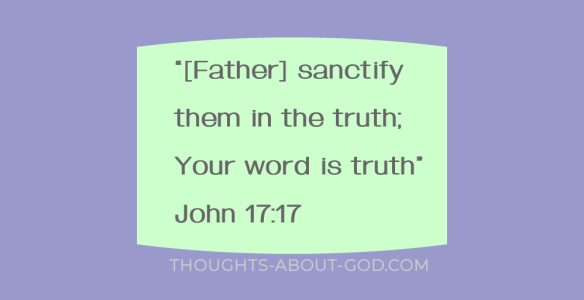
Jesus prayed, “[Father] sanctify them in the truth; Your word is truth” (John 17:17). He was saying, “Father, purify them of the lies and illusions of this age through Your penetrating Word.” In Ephesians, Paul tells us that Christ sanctifies the church by cleansing her “by the washing of water with the word . . . that she would be holy and blameless” (Ephesians 5:26-27).
This then, embracing the Spirit of Truth and allowing the Word of truth to break the patterns of falsehood and deception in our lives is the process through which we become Christlike — and this process begins in earnest when we not only hear the truth, but when we love it.
By Francis Frangipane
Used by Permission
Further Reading
• Truth – By Katherine Kehler
• Truth Can Set You Free – by Charles Stanley
• Truth Be Told – by Melissa Talbot
SUBSCRIBE BY EMAIL: FOLLOW THIS LINK
Follow Us On: Facebook • Twitter • Instagram • Pinterest
The post Loving the Truth can be found online at Daily Devotionals by Thoughts about God.
from Daily Devotionals by Thoughts about God https://ift.tt/O1L4t8e
via IFTTT
The Pain of Letting Go
“The Lord will perfect that which concerns me; Your mercy and loving-kindness, O Lord, endures forever–forsake not the works of Your own hands.” Psalm 138:8 (Amplified Bible )
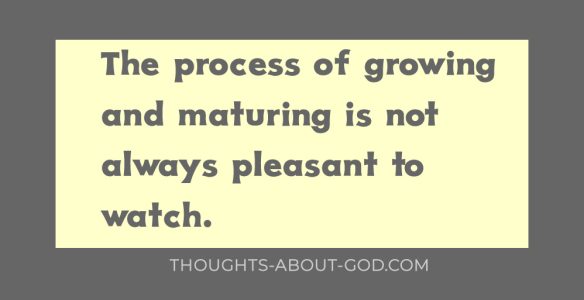
The story of the Prodigal son weighed on my heart today. Watching the Father allow his youngest son to leave home and experience life reminds me of the challenges we face as parents to our natural and spiritual children. The process of growing and maturing is not always pleasant to watch. We cannot raise strong, responsible children or even spiritual sons and daughters by shielding them from all pain and hardships, especially those that come from their own decisions. Often times it is the pain that leads them to the arms of the Father.
There comes a time, as parents, we must release our control and learn to trust God in the process. Looking back at the Father in the parable, he knew that he had to allow his son to leave. But he also knew that he could trust the Lord with what was precious to him, the life of his son. We too must allow our heavenly Father to mature our children and bring them to perfect stature in Him. Just as the prodigal son came to himself realizing that he had it better with his father, our seed will as well. It may not be an easy transition but it is a necessary one.
Father, grant us the grace to trust you with the lives of those we love. Lord, teach us continually how to guide them in wisdom and truth. As we commit them to you, I ask that you reassure us daily that you will complete the work that you have begun in them.
Scriptural References
Luke 15:11-24
Psalm 57:2
Philippians 1:6
2 Timothy 1:12
Isaiah 54:13
By Mary Pinckney
Used by Permission
Further Reading
• The Father is Waiting -by Helen Lescheid
• Hitting Rock Bottom – by Katy Huth Jones
The post The Pain of Letting Go can be found online at Daily Devotionals by Thoughts about God.
from Daily Devotionals by Thoughts about God https://ift.tt/76IQBWx
via IFTTT
Subscribe to:
Posts (Atom)
30 Ways to Love Christ in the Everyday Moments of Life
Image by Camile Garzon Disclosure: This post may contain affiliate links, meaning Beautiful Christian Life LLC may get a commission if ...

-
Photo by James Coleman on Unsplash Disclosure: This post may contain affiliate links, meaning Beautiful Christian Life LLC may get a c...
-
Image by Camile Garzon Disclosure: This post may contain affiliate links, meaning Beautiful Christian Life LLC may get a commission if ...
-
Image by Arianne Autaubo Disclosure: This post may contain affiliate links, meaning Beautiful Christian Life LLC may get a commission i...


